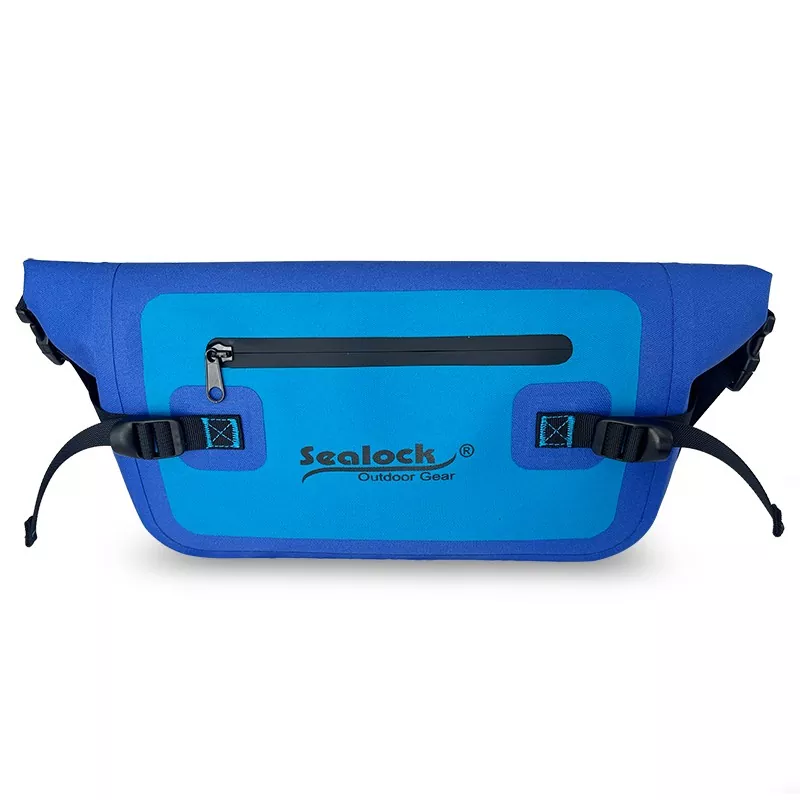
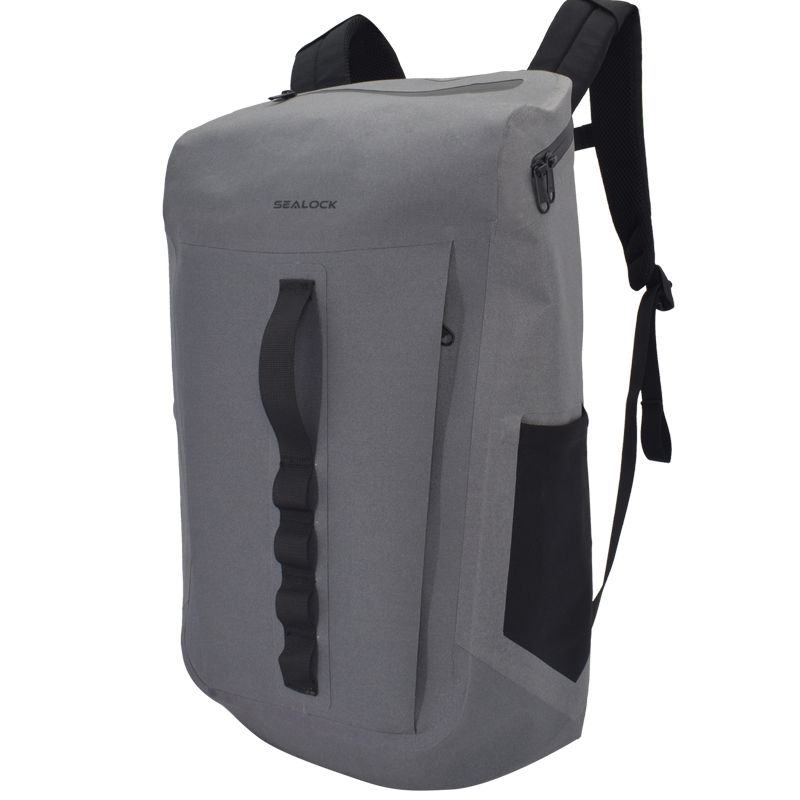
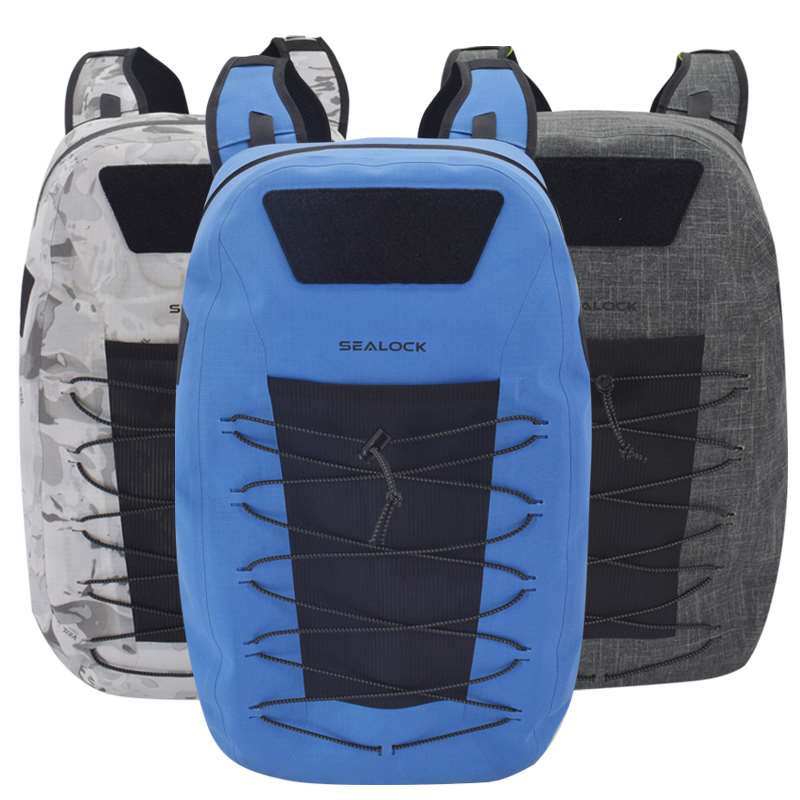
Sealock is a waterproof travel bag manufacturer, and a waterproof travel bag packs differently from a hard suitcase. It's usually one large sealed compartment with a roll-top or watertight zipper, and it can carry wet and dry gear together without ruining anything. Pack it the right way and you fit more, keep the load balanced, and keep the closure sealing properly. This guide walks through a method that gets the most out of that single dry space.
Know Your Bag First
Before folding a single shirt, it helps to understand what you're packing into. A waterproof duffel or holdall doesn't have the fixed shelves and lid of a suitcase — it's one open cavity, which is a strength (nothing wasted on internal structure) and a challenge (things shift if you don't organize them). Two features shape how you pack it: the closure (a roll-top needs room left at the top to roll and seal; a watertight zipper shouldn't be forced over an overstuffed bag) and the waterproof shell, which lets you pack wet items alongside dry ones as long as you separate them. Work with those two things and the rest is method.
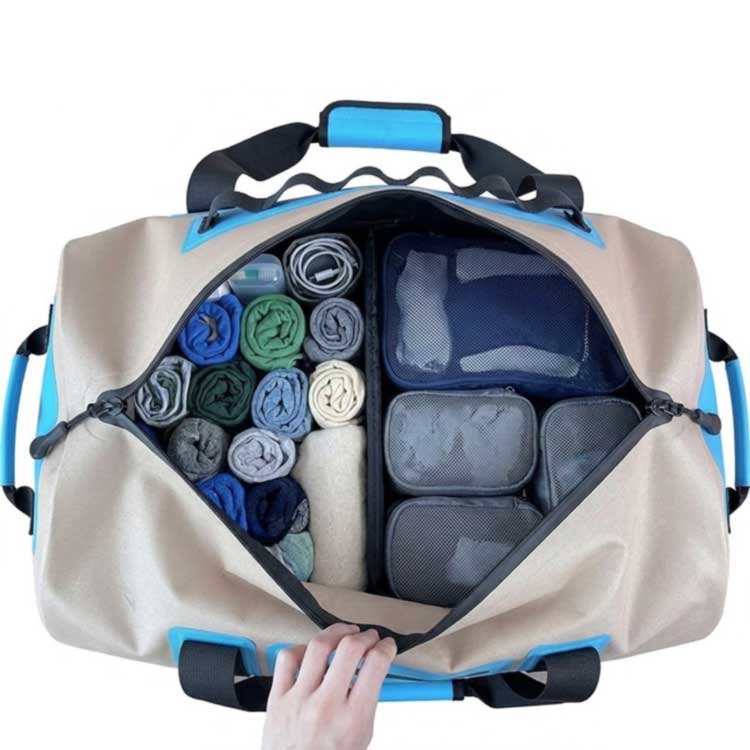
One large sealed compartment — organize it and it holds more than it looks.
The Core Method: Layer, Roll, Compress
Roll, Don't Fold
Rolling soft clothing — shirts, base layers, trousers — packs more into the same volume than folding and leaves fewer creases. Rolled items also stack and wedge into the gaps around bulkier gear, so the single compartment fills evenly instead of leaving air pockets.
Layer by Weight and Access
Put the heaviest, densest items — shoes, toiletries, a charger brick — at the bottom of the bag, which becomes the back panel when it's carried, keeping weight low and close to your body. Lighter clothing goes on top. Then think about access: anything you'll want first (a rain shell, a change of clothes, chargers) goes last, on top, where you can reach it without unpacking the whole bag.
Use Packing Cubes or Compression
Packing cubes bring suitcase-style order to a duffel's open cavity: they group outfits, keep the load from shifting, and let you lift a whole category out at once. A compression cube or a roll-sack squeezes bulky, air-heavy items — a puffy, spare layers — down to a fraction of their size, which is where a big duffel suddenly swallows more than expected.
Use the Waterproof Features
Separate Wet From Dry
The real advantage of a waterproof bag on a trip is carrying wet gear without soaking everything else. Keep damp swimwear, a wet towel, or muddy shoes in a dedicated waterproof pocket or a sealed dry-sack inside the main compartment. A model like the SL-C350 80L Duffle has a waterproof side pocket built for wet shoes, so a beach or rain day doesn't spread through your clothes.
Respect the Closure
A waterproof closure only seals if you let it. A roll-top needs three to four full rolls to be watertight, so leave the top few inches unpacked rather than cramming to the brim — an overfilled roll-top can't seal and defeats the point of the bag. A watertight zipper should glide shut without straining over a bulging load; pack so the sides meet easily.
Protect Electronics and Documents
Even in a waterproof bag, keep a laptop, camera, passport, and papers in a padded dry pouch in the centre of the load, cushioned by clothing on all sides. That protects them from both moisture (if the bag is opened in the rain) and the knocks of transit.
Pack to the Limits
Efficiency isn't only about fitting more — it's about fitting it within airline rules and a comfortable carry. Keep a carry-on packed within cabin size (most carriers around 56×36×23 cm) and a checked bag under the weight cap (often 23 kg / 50 lb). Weigh the packed bag at home with a luggage scale, and distribute the load so it sits balanced rather than sagging to one end — a lopsided duffel is miserable to carry and awkward on a scale.
A Simple Packing Order
Lay the empty bag open and flat.
Heavy, dense items first, along the base (shoes in a bag, toiletry kit, charger brick).
Rolled clothing and packing cubes next, filling the middle evenly.
Compressed bulky layers (puffy, spare warm kit) squeezed in to reclaim space.
Wet or dirty items into the dedicated waterproof pocket, kept separate.
Electronics and documents in a padded dry pouch, centred and cushioned.
Quick-access items (rain shell, snacks, chargers) on top.
Roll the top three to four times or close the watertight zipper without forcing it.
Which Bag Makes Packing Easier
The bag itself does part of the work. Matching size to trip length, a wet-shoe pocket, and a convertible carry all make efficient packing simpler:
Built-in wet/dry separation for shoes and damp kit
500D PVC
300
Luggage Set Travel Bags — large tote/duffel; fully sealed, 100% waterproof; HF-welded; silk-print logo.
Split the load across a main hauler and a day bag
420D nylon TPU
300–500
Built to Pack Hard
An efficiently packed bag is a full, heavy bag, so the build has to take it. Sealock's travel bags come from a factory with over twenty years in welded waterproof bags and OEM work for names including Osprey and F/CE. Every body is high-frequency welded and proven with a real water-submersion test, and quality is gated across IQC (incoming materials), IPQC (in-process), and OQC (outgoing, with AQL sampling and a submersion batch test). Load testing to 1,500+ cycles and a colour-fastness and colour-difference check mean a fully packed bag holds its shape, seams, and colour trip after trip.
OEM / ODM Terms
Item
Detail
MOQ
300–500 pcs (category-dependent)
Sampling
7–15 days
Customisation
Capacity, internal dividers/pockets, wet-dry pocket, colour, closure, logo
Inspection
IQC + IPQC + OQC (incl. real water-submersion batch test)
Trade terms
FOB Guangdong; China or Vietnam origin
FAQ: Packing Questions
Q: How do I pack wet clothes or shoes without soaking everything?
A: Keep them separate inside a waterproof pocket or a sealed dry-sack within the main compartment. A bag with a dedicated wet-shoe pocket (like the SL-C350) does this by design, so damp kit never touches your clothes.
Q: How do I stop a duffel's contents from collapsing and shifting?
A: Packing cubes are the fix — they give the open cavity structure, hold outfits together, and keep the load from sliding. Fill gaps with rolled clothing so nothing has room to move.
Q: Do packing cubes work in a waterproof duffel?
A: Yes, and they help a lot. A duffel has no internal shelves, so cubes bring the organization a suitcase has built in, while you keep the duffel's capacity and waterproofing.
Q: How do I keep a packed bag under the airline weight limit?
A: Weigh it at home with a luggage scale, and lean on a light TPU bag so more of the allowance goes to contents. Move dense items to your carry-on if the checked bag is close to the cap.
Q: My roll-top won't seal — what am I doing wrong?
A: It's overpacked. A roll-top needs three to four full rolls of empty material at the top to seal; leave the top few inches clear, or size up to the next capacity so the closure can do its job.
Talk to the Factory
For quotes, samples, or an OEM/ODM proposal on a waterproof travel bag — including custom internal dividers and wet-dry pockets that make packing easier — reach Sealock at info@sealock.com.hk or +86-769-82009361. Over twenty years in welded waterproof bags and dual China–Vietnam production.
We use cookies to offer you a better browsing experience, analyze site traffic and personalize content. By using this site, you agree to our use of cookies.
Privacy Policy
 English
  Español
  Português
  русский
  Français
  日本語
日本語  Deutsch
  tiếng Việt
  Italiano
  Nederlands
  ภาษาไทย
  Polski
  Svenska
  magyar
  Malay
Malay  বাংলা ভাষার
  Dansk
Dansk  Suomi
Suomi  हिन्दी
  Pilipino
  한국어
한국어  Türkçe
  Gaeilge
  العربية
  Indonesia
  Norsk
Norsk  تمل
تمل  český
český  ελληνικά
  український
  Javanese
  فارسی
فارسی  தமிழ்
தமிழ்  తెలుగు
  नेपाली
  Burmese
  български
  ລາວ
ລາວ  Latine
  Қазақша
  Euskal
  Azərbaycan
  Slovenský jazyk
  Македонски
  Lietuvos
  Eesti Keel
  Română
  Slovenski
  मराठी
मराठी  Srpski језик