Sealock is a custom waterproof waist pack manufacturer and OEM supplier. Ordering a custom waist pack is deceptively easy to get wrong: the bag is small, the quote looks simple, and the word "waterproof" appears on every listing — yet the difference between a pack that survives a dunk and one that leaks in twelve seconds is invisible on a spec sheet. This guide walks a buyer through the decisions in the order they actually come up, from writing the brief to approving the shipment.
Step 1: Define the Use Case Before Anything Else
Every downstream decision — material, closure, rating, cost — follows from one question: what will the pack actually face? Be specific about the worst case, not the average one:
Will it be submerged? Kayaking, SUP, swimming, and river crossings mean the pack must survive full immersion, not just rain.
Will it face abrasion? Fishing, boat decks, and rock scrambling demand a heavier fabric.
Will it be worn in motion for hours? Running and hiking make belt comfort and bounce as important as sealing.
What goes inside? A phone and passport need a sealed compartment; cash and cards need a fast-access pocket.
Sizing follows: measure the largest item the pack must hold and add room for easy access. Most waist packs land between 2L and 4.5L — enough for a phone, wallet, keys, and essentials without the bulk that gets a pack left behind.
The brief decides the bag — material, closure, and rating all follow the use case.
Step 2: Specify a Number, Not the Word "Waterproof"
"Waterproof" is a marketing word, not a specification. In an RFQ, ask for the standard in numbers — an IPX level with a test report you can see:
IPX4–IPX6 — splash and heavy spray; adequate for commuting and general outdoor use, not immersion.
IPX7 — submersion at 1 metre for 30 minutes; the benchmark for water-sports packs.
IPX8 — continuous immersion beyond IPX7, to a depth the manufacturer states.
One trap catches buyers repeatedly: a high denier is not waterproofing. Denier measures thread thickness and durability, not water resistance — a 1000D fabric with no coating and stitched seams will still soak through. Ask for the coating type (TPU, PVC, PU) and the seam method separately from the fabric weight.
Step 3: Insist on Welded Seams and an Honest Closure Spec
The seam is where a waterproof waist pack lives or dies. Stitching punches needle holes straight through the barrier; taped seams help but the adhesive lifts over time. Only high-frequency welding (27.12 MHz) fuses the panels with no perforation, producing a seam as watertight as the fabric itself. If submersion matters to your customer, welded is not optional.
Then be honest about the closure. A genuinely submersible pack uses an airtight zipper on the main compartment; a standard or splash-proof zip is an open channel. The credible structure is a sealed main compartment paired with a water-resistant front pocket for cash, cards, and a phone — rating each pocket separately rather than making one vague claim across the whole bag. It also solves a usability problem, since an airtight zipper is inherently stiff and awkward one-handed. The underlying construction is set out in our waterproof waist pack manufacturer overview.
Step 4: Spec the Comfort, Not Just the Seal
A perfectly sealed pack that bounces or chafes still gets returned. The comfort spec is a real part of the brief:
Belt width and padding — a wider, padded belt distributes load and reduces bounce; a narrow webbing strap digs into the hips.
Adjustment range — a belt that doesn't extend far enough excludes a share of the market; enough range to wear it at the waist or across the chest widens the fit.
Back panel — a sealed panel against the body traps heat, so specify breathable padding.
Hardware — a quick-release buckle, D-rings, lash webbing, and side loops for attaching gear; reflective trim for low light.
Load geometry — how the weight sits against the hips decides whether the pack rides quietly. Wear-test a loaded sample in motion before bulk.
Step 5: Test the Sample — Don't Approve on Paper
This is the step that separates a good order from an expensive one. A supplier can hand over a passing fabric spec and claim the finished bag is IPX7; drop that sealed bag in a dunk tank and the zipper can leak in seconds. Never approve a production run on a spec sheet alone. When your sample arrives:
Put tissue or absorbent paper inside — the simplest way to see whether any water gets in.
Submerge it — fully immerse the sealed pack and hold it under, matching the rating you specified.
Press and load it — press on the closure and add weight to mimic pressure; leaks show up under load that don't show at rest.
Try the reverse test — fill it with water, seal it, and lay it flat; if water escapes, the seams aren't sealed.
Watch where water appears first — the zipper path, seam lines, corners, strap attachment points, and any logo patch that punctures the shell.
Wear it loaded — walk, run, and ride with it to check for bounce and chafe
Step 6: Lock the Terms — MOQ, Sampling, Production
Get the commercial terms in writing before you fall in love with a sample. For welded waterproof waist packs, plan around:
MOQ — typically 300–500 pieces per model, depending on design and materials.
Sampling — around 7–15 days for a customized base model. A fully custom design that needs a new welding mould takes longer, since the tooling has to be made first.
Production — roughly 30–45 days after sample approval.
Inspection window — budget extra days for a third-party inspection; booking an inspector typically needs advance notice, and any re-work extends the timeline.
Origin — a China or Vietnam production base can change your landed cost depending on your market's tariff schedule.
Step 7: Gate the Bulk Order
A sample proves capability; a quality system proves consistency. Require a signed golden sample that the whole order is measured against, and confirm the supplier gates quality in three tiers — IQC on incoming materials, IPQC in process, and OQC before shipment with AQL sampling and a submersion batch test on finished goods. Then add an independent pre-shipment inspection before releasing final payment. A capable factory welcomes it. The wider supplier-vetting framework is in our guide to choosing a waterproof bag supplier, and the private-label path in our custom private-label guide.
Common Buying Mistakes
Approving on a spec sheet — a fabric figure is not a finished-bag result.
Equating denier with waterproofing — thickness is not sealing.
Writing "waterproof" instead of a number — leaving the standard undefined invites a weaker build. One European buyer specified only "high water resistance," got a bag with unsealed seams, and lost the order to field testing when rain got through the stitch lines.
Ignoring comfort — bounce and chafe drive returns as surely as leaks.
Skipping the inspection — the pre-shipment check is your last leverage.
The Product Basis
These welded packs, from Sealock's waterproof waist pack line, are equal starting points to specify against — none is ranked above another; pick whichever base is closest to your use case and customize from there:
Model & specs
Use case
Construction
MOQ
SL-F115 Waterproof Sling Waist Pack — approx. 3L (24×8×15.5 cm), 0.56 kg; 500D PVC; IPX7; airtight waterproof main zipper + water-resistant front zip pocket; breathable padded back panel; adjustable, removable webbing strap with quick-release buckle; dual D-rings, front lash webbing, side loops; black, yellow, grey, orange (custom available).
Water sports, hiking, cycling; waist or crossbody
HF-welded; IPX7 airtight zipper
300
Waterproof Fishing Waist Bag — 840D TPU with waterproof zipper; expandable side waist belt; reflective front pocket; side pocket for a 1.5L bottle.
Fishing, abrasion-heavy, deeper water
HF-welded; heavy 840D TPU
300
SL-F142 Waterproof Fishing Waist Bag — 4.5L; 420D TPU tarpaulin; waterproof zipper; reflective front pocket for low light; side pocket for a 1.5L bottle; expandable side waist belt; black, blue, yellow, orange, grey; silk-screen; BSCI.
Sea, river & lure fishing; deeper water, low light
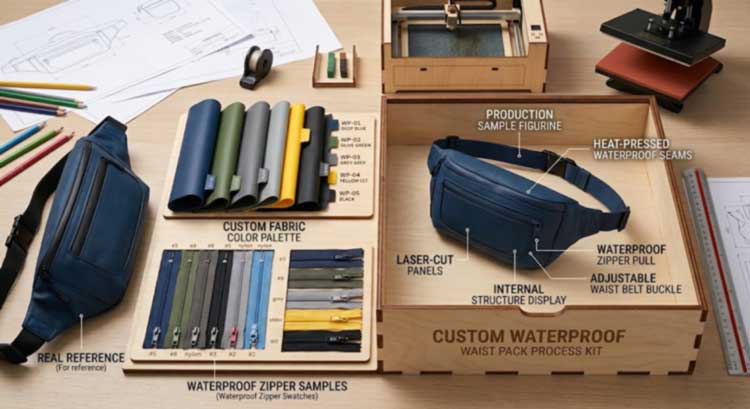
Customization spans capacity and shape, material and denier, closure type, belt system, back panel, hardware, reflective trim, colourway, and branding by silk-screen, hot-pressing, or welded logo — plus ground-up development from a sketch or reference sample.
FAQ: Buying Custom Waterproof Waist Packs
Q: How do I verify a "waterproof" claim before I commit to bulk?
A: Test the finished sample, not the spec sheet. Put tissue inside, submerge it to the rating you specified, press the closure, and add weight. Suppliers have claimed IPX7 on a fabric spec while the sealed bag leaked at the zipper within seconds — the dunk test is the only proof that counts.
Q: Does a higher denier mean the pack is more waterproof?
A: No. Denier measures thread thickness and durability, not water protection. A thick fabric with no proper coating and stitched seams will still soak through. Specify the coating (TPU/PVC) and the seam method separately.
Q: What IPX rating should I specify?
A: Match it to the worst case: IPX4–IPX6 for splash and rain, IPX7 (1 m for 30 minutes) for water sports and genuine submersion, IPX8 for deeper or longer immersion. Ask for a test you can see, not the word alone.
Q: Why do sealed packs have a separate front pocket that isn't fully waterproof?
A: Because an airtight zipper is stiff and hard to open one-handed. The honest design pairs a sealed main compartment for a phone and passport with a water-resistant front pocket for the cash and cards you reach for on the move — and rating each pocket separately is more credible than one blanket claim.
Q: How long does a fully custom pack take compared to customizing a base model?
A: A customized base model samples in about 7–15 days. A ground-up design takes longer because a new welding mould has to be made first. Production is then roughly 30–45 days after approval, so brief early against your launch date.
Q: What stops the bulk order drifting from the sample I approved?
A: A signed golden sample, three-tier quality gating (IQC/IPQC/OQC with AQL sampling and a submersion batch test), and an independent pre-shipment inspection before final payment.
Talk to the Factory
To spec and sample a custom waterproof waist pack, contact Sealock at info@sealock.com.hk or +86-769-82009361. Over twenty years in welded waterproof bags, a China–Vietnam dual-base option, and finished-product submersion testing you can verify yourself.
We use cookies to offer you a better browsing experience, analyze site traffic and personalize content. By using this site, you agree to our use of cookies.
Privacy Policy
 English
  Español
  Português
  русский
  Français
  日本語
日本語  Deutsch
  tiếng Việt
  Italiano
  Nederlands
  ภาษาไทย
  Polski
  Svenska
  magyar
  Malay
Malay  বাংলা ভাষার
  Dansk
Dansk  Suomi
Suomi  हिन्दी
  Pilipino
  한국어
한국어  Türkçe
  Gaeilge
  العربية
  Indonesia
  Norsk
Norsk  تمل
تمل  český
český  ελληνικά
  український
  Javanese
  فارسی
فارسی  தமிழ்
தமிழ்  తెలుగు
  नेपाली
  Burmese
  български
  ລາວ
ລາວ  Latine
  Қазақша
  Euskal
  Azərbaycan
  Slovenský jazyk
  Македонски
  Lietuvos
  Eesti Keel
  Română
  Slovenski
  मराठी
मराठी  Srpski језик