Sealock manufactures waterproof duffel bags in both TPU and PVC, so buyers ask the factory point-blank which material lasts longer. It isn't a marketing question — it shows up directly in return rates and reviews. Most waterproof bags don't fail on day one; they age slowly: stiffening in the cold so they won't roll, off-gassing a chemical smell, or cracking and fading after a few sunny trips.
A TPU and a PVC waterproof duffel bag side by side.
Quick Answer
On longevity, TPU usually wins: it stays flexible in the cold, resists UV, survives thousands of fold cycles, and barely off-gasses. PVC's strengths are low cost and brute abrasion resistance in a heavy gauge. In one line: choose TPU for long service life and cold or sun-exposed use; choose PVC for value and heavy-duty abrasion. Both can be fully welded and waterproof — the real gap is how fast each ages.
Factor
TPU
PVC
Cold flex
Stays supple in deep cold
Stiffens / can crack
UV resistance
Strong
Fades / yellows faster
Odor
Minimal
Plasticizer smell
Weight
10–30% lighter
Heavier
Abrasion (heavy gauge)
Very good
Excellent
Cost
Higher
Lower
Who Builds Them: The Manufacturer
The bags compared here come from Sealock Outdoor Gear Co., Ltd., a welded-bag specialist now past its 21st year. What makes its read on this question worth trusting is simple — the same workshops coat TPU and laminate PVC every week, so the verdict isn't bent toward whatever the plant happens to stock. That neutrality sits on real scale: shipments into 40-plus countries, a stack of 20-plus waterproofing patents, and contract builds for marine and outdoor labels including Helly Hansen, Musto, Simms, and Osprey.
Factories & Certifications
The Dongguan site alone runs 12,000 m² with 400+ staff, nine high-frequency welding lines, and around 100,000 units of monthly output.
Two Ho Chi Minh City plants give US accounts a lower-tariff routing into Vietnam.
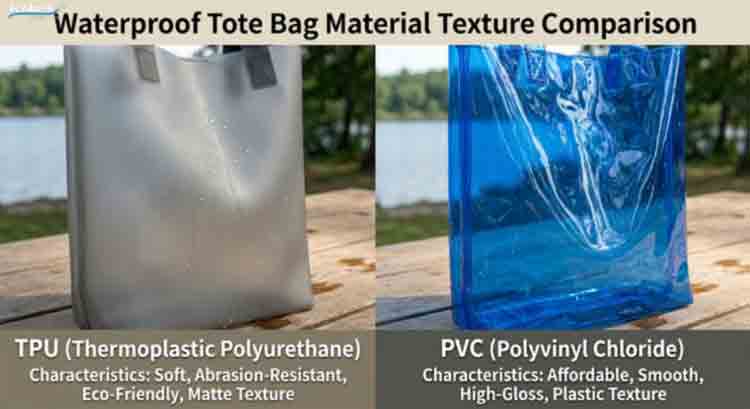
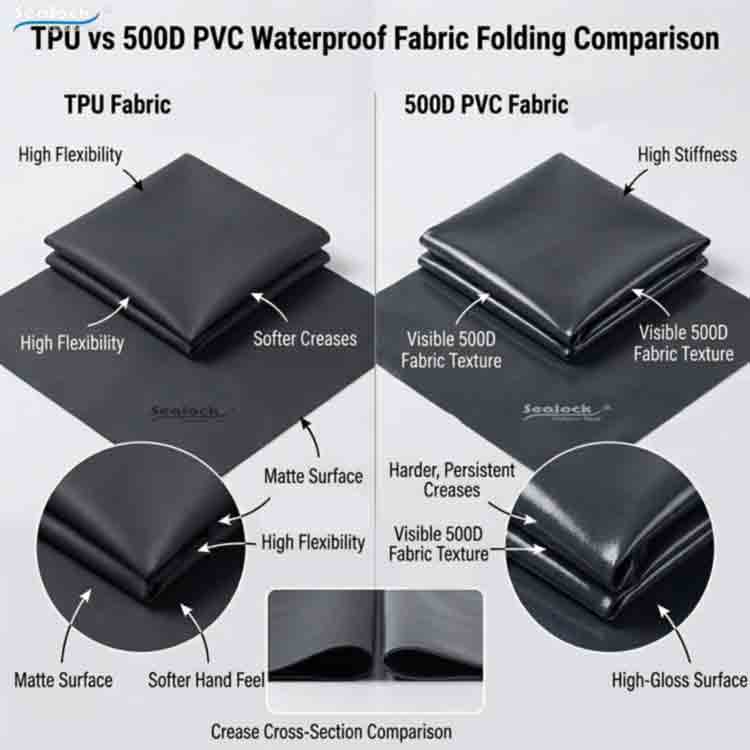
TPU (thermoplastic polyurethane) doesn't rely on heavy plasticizers to stay soft, so it stays flexible in the cold (no brittle cracking), resists UV, survives thousands of fold cycles without splitting, and barely smells. For the same waterproofing it also runs 10–30% lighter than PVC. The trade-off is a higher unit price. Sealock typically uses 420D/500D/840D TPU.
TPU vs 500D PVC fabric in a fold and abrasion comparison.
Where PVC Wins — and Where It Doesn't
PVC (polyvinyl chloride) is cheaper and, in a heavy gauge like 500D tarpaulin, brutally abrasion-resistant up front — a value pick for strapped, heavy-load bags. Its weakness is long-term ageing: it relies on plasticizers to stay soft, so it stiffens over time, gets more brittle in cold, often carries a stronger new-bag odor, and fades or yellows faster in strong sun. The right gauge and a REACH-compliant plasticizer extend its life considerably.
Don't Overlook the Seam — It Fails First
Material aside, both fabrics are joined the same way. A 27.12 MHz high-frequency weld melts the panels into one seamless wall with nothing for a needle to pierce, and every finished body is held to a 1.0 Bar external-pressure check. Years of warranty claims teach a blunt lesson: on a budget bag the cloth rarely quits before the join does, so the TPU-versus-PVC debate is academic until the weld is sound.
The TPU camp is led by the Unplug Ultimate Adventure Bag (converts to backpack, duffel, or dry-sack) and the TPU travel bag — light, supple, durable. The PVC camp is the 80L PVC duffel — brute strength at a lower price. When a buyer needs higher-strength TPU, the factory can move up to 840D double-sided lamination.
Quality Control: How Lifespan Is Verified
"Durable" can't be a slogan, so the factory measures it across five gates:
Roll inspection — each fabric roll is graded for gauge, coating evenness, and surface flaws before any panel is cut.
Seam pull-tests — welded joints are loaded until the fabric, not the weld, becomes the weaker link.
Pressure check — assembled bodies sit under the 1.0 Bar external-pressure test to prove the seal.
Ageing samples — sample units face cold-fold and UV exposure to stand in for seasons of real use.
Pre-ship sign-off — colour match, print position, and carton counts are cleared before dispatch.
Which Should a Buyer Choose?
Choose TPU — cold or high-altitude markets, heavy sun, premium or eco positioning, and when low long-term returns matter most.
Choose PVC — budget-sensitive, high-volume promo, warm climates, or when a thick gauge must shrug off abrasion.
Stock both — TPU as the premium tier, PVC as the entry tier, covering every price point.
OEM / ODM: Either Material, Fully Custom
OEM and ODM cover the full path from a buyer's sketch to a shippable, audit-ready bag — and since both materials live under one roof, a programme can move between TPU and PVC without switching suppliers. The commercial baseline:
Item
Detail
MOQ
300–500 pcs (category-dependent)
Sampling
7–15 days
Material options
420D/840D TPU or 500D PVC
Customisation
Colour, size, silk-screen logo, packaging
Trade terms
FOB Guangdong; China or Vietnam origin
FAQ: Real Material Pain Points From the Reviews
Q: Reviews say PVC bags stiffen or even crack in winter — for a TPU vs PVC waterproof duffel bag, which suits cold regions?
A: Cold cracking is PVC's most common long-term complaint; it stiffens noticeably and can split around −20°C. TPU stays flexible in deep cold, so a TPU waterproof duffel bag is the pick for cold or high-altitude markets. If PVC is required, a thicker gauge and a cold-rated formula are essential.
Q: A frequent complaint is a chemical smell out of the box — is there a big odor gap between TPU and PVC?
A: Yes, a clear one. PVC uses plasticizers to stay soft, so new bags often off-gas, and many reviews flag a harsh out-of-box smell. TPU has minimal plasticizer and barely smells, making a TPU waterproof duffel bag better for clothing, food-contact use, or odor-sensitive buyers.
Q: Buyers say a bag faded and went brittle after a few sunny trips — which material resists UV better?
A: Strong sun accelerates PVC cracking and yellows or bleaches the color, and ageing tests show PVC losing strength within months. TPU resists UV better, so it suits beach, boating, and long outdoor exposure.
Q: Some reviews mention the coating peeling or delaminating within months — how is that avoided?
A: Delamination shows up most on cheap thin-gauge PVC promo bags that peel in months, while quality TPU lamination lasts years. Sealock uses 420D/840D TPU or heavy-gauge 500D PVC and bonds with high-frequency welding rather than glue, cutting the peel risk at the source.
Q: Bottom line — for a TPU vs PVC waterproof duffel bag, which lasts longer?
A: Across cold, UV, fold fatigue, and odor, TPU usually lasts longer with lower returns; PVC wins on price and heavy-gauge abrasion. Judged purely on service life, TPU leads in most scenarios, while PVC is the smarter buy when budget and brute abrasion come first.
Talk to the Factory
To price a sample, request a swatch set, or scope an OEM run in either material, the Sealock desk answers at info@sealock.com.hk and +86-769-82009361. One roof, two material lines, and a straight call on whichever holds up longer for the climate and price point in play.
We use cookies to offer you a better browsing experience, analyze site traffic and personalize content. By using this site, you agree to our use of cookies.
Privacy Policy
 English
  Español
  Português
  русский
  Français
  日本語
日本語  Deutsch
  tiếng Việt
  Italiano
  Nederlands
  ภาษาไทย
  Polski
  Svenska
  magyar
  Malay
Malay  বাংলা ভাষার
  Dansk
Dansk  Suomi
Suomi  हिन्दी
  Pilipino
  한국어
한국어  Türkçe
  Gaeilge
  العربية
  Indonesia
  Norsk
Norsk  تمل
تمل  český
český  ελληνικά
  український
  Javanese
  فارسی
فارسی  தமிழ்
தமிழ்  తెలుగు
  नेपाली
  Burmese
  български
  ລາວ
ລາວ  Latine
  Қазақша
  Euskal
  Azərbaycan
  Slovenský jazyk
  Македонски
  Lietuvos
  Eesti Keel
  Română
  Slovenski
  मराठी
मराठी  Srpski језик